GNSS is heavily relied upon within civil aviation for providing positioning, navigation, and timing (PNT) services to flight crews and air traffic control (ATC), and is likely to become even more core to operations going forward as the industry seeks to phase out older and more expensive ground-based solutions.
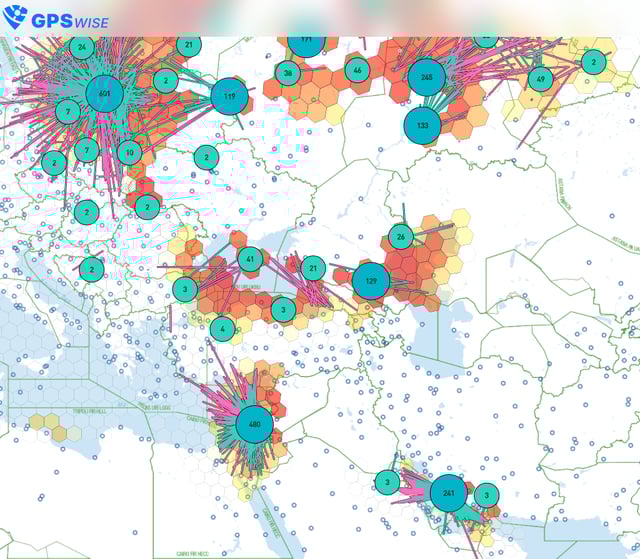
GNSS signals though are fragile, and can be easily disrupted through inadvertent interference or deliberate jamming that undermines or completely blocks GNSS positioning. More critically, GNSS signals can be spoofed through the broadcast of false positioning and timing data; such a practise is common in conflict zones around the world, but also inadvertently impacts on any civil aircraft operating in the area.
This is a rising problem, and a threat to civil aviation in many parts of the world with more than 800 flights being disrupted daily, and peaking at 1500 flights on some days.
Loss of GNSS has serious operational ramifications
For both flight crews and ATC alike, a loss of GNSS positioning increases workload, stress, and impacts aircraft safety, as well as driving up operational cost.
Flight diversion
Flights may need to be diverted – extending flying time, increasing fuel burn, and with knock-on scheduling impacts and payouts for passenger compensation.
Flight path drift
Aircraft can subtly drift or turn off route and risk entering restricted or military areas without authorisation, and without the flight crew being aware.

False-positive terrain warnings
False terrain warnings can result in an automatic or startle 'pull-up' response potentially leading to aircraft stall.

Datalink loss
Aircraft clock corruption can cause downstream errors in datalink systems that result in the ground system disconnecting from the aircraft.
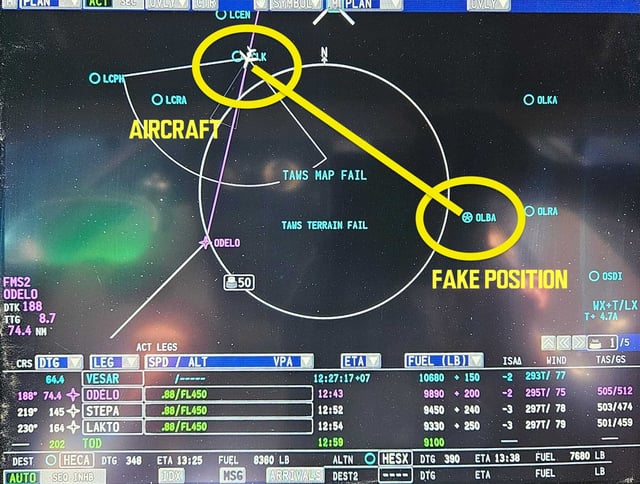
What's more, these problems are difficult to manage, and especially so in the case of GNSS spoofing where the GNSS receiver often becomes contaminated with false system settings and may continue to calculate incorrect position even after the aircraft leaves the spoofing area.
Furthermore, there's often no way of isolating the GNSS receiver and stopping its contaminated positioning data from affecting critical safety systems such as EGPWS/TAWS.
In essence, GNSS spoofing puts the aircraft into a significantly degraded state, creating a stressful and higher-risk operating environment for the flight crew to deal with as well as severely compromising ATC surveillance.
Helix Geospace CRPxTM technology
Helix Geospace develop cutting-edge GNSS anti-jamming CRPA technology that is ideal for tackling the problems faced by the civil aviation industry and the considerable risk to existing aircraft operating today in or around conflict zones.
 CRPx has been developed in the UK with full UK/EU/NATO supply chain provenance.

Engineered for a wide range of applications
Maritime
GNSS is critical for navigation in modern maritime operations but increasingly under threat.
Learn more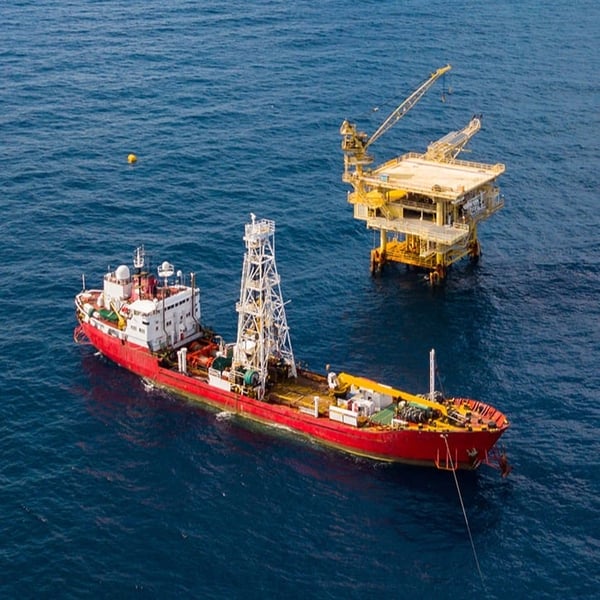
Drones (UAVs)
Resilient GNSS in a compact form factor is fundamental to the operation of drones & UAVs.
Learn more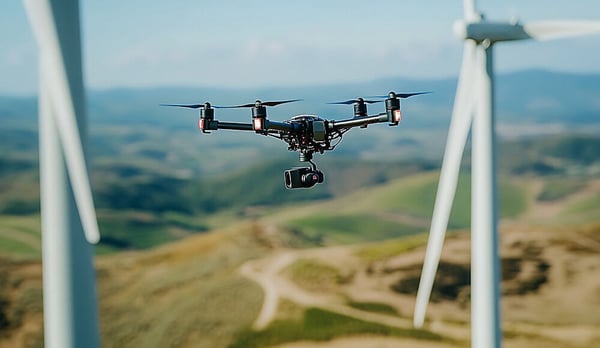
Military UxVs
Unmanned aerial and surface vehicles (UxVs) are revolutionising modern warfare but crucially dependent on resilient GNSS.
Learn more