
Controlled Reception Pattern Antennas (CRPAs) are the gold standard for tackling GNSS jamming. But with a variety of options now being brought to market, which should you choose?
GNSS is under attack
In an increasingly interconnected world, GPS and other global navigation satellite systems (GNSS) are fundamental not only to navigation but also to many other applications that rely on positioning or time synchronisation.
GNSS though is increasingly under threat, be that from unintentional RF interference or deliberate jamming by attackers seeking to disrupt, deny or spoof GNSS services.
Mitigation strategies can be employed at many points in the GNSS chain but arguably the most effective is to combat jamming at the antenna level.
CRPA is the answer, but which one?
Controlled Reception Pattern Antennas (CRPA) are active systems that modify their reception patterns in realtime to neutralise interference and jamming whilst (in some cases) also beamforming towards the GNSS satellites to maximise signal reception.
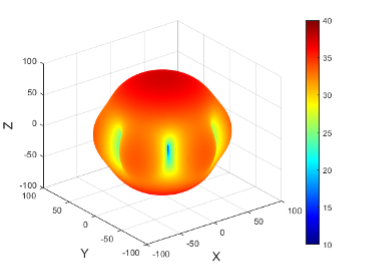
Example CRPA reception pattern
With CRPA technology being removed from the ITAR list in 2025, it's opened it up for use in civil as well as military applications.
But with a variety of CRPA options now being brought to market, which should you choose?
The choice very much depends on your application and the environment you'll be operating in.
Whilst the primary objective of a CRPA is to combat interference and jamming, the way it chooses to achieve this can have a crucial impact on how well the CRPA performs as a GNSS antenna (its main function) and whether its form factor, power requirements and cost align with the application in question.
To give an example, CRPAs are active by design and need to be powered - whilst some may only need a few Watts of power to operate, others can require upwards of 20-30W, far too much to be usable on power-constrained platforms such as drones and other UAVs (Uncrewed Aerial Vehicles).
Some CRPA designs may also sacrifice GNSS signal linearity and phase coherence in the pursuit of better jamming suppression; this may not be an issue for applications in heavily-contested environments where obtaining any positional fix is a challenge, but for applications reliant on phase-based GNSS measurements (such as RTK), minimal phase centre offset (PCO) and variation (PCV) are fundamental to obtaining better positional accuracy.
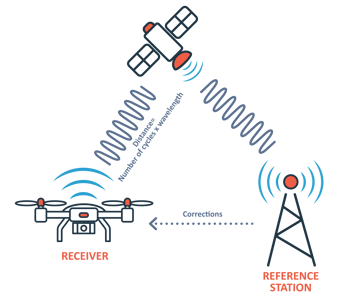
Phase-based measurements & correction for better positional accuracy
Key criteria for evaluating CRPA options
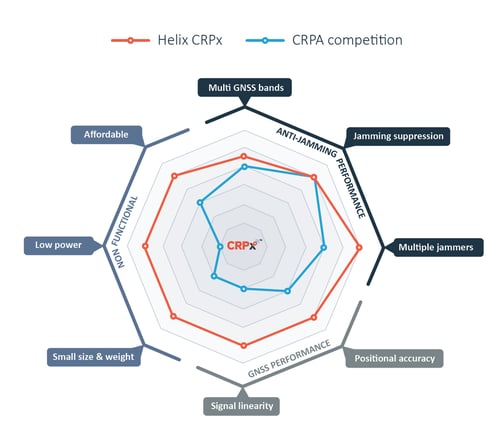
In order to further explore a range of different applications and their respective requirements, a set of eight CRPA evaluation criteria have been selected, grouped into 3 categories:
Anti-jamming performance
- Multiple GNSS bands
- Increasing the number of GNSS bands and constellations supported by the CRPA maximises the number of satellites in view, improving both resilience and positional accuracy
- Jamming suppression
- The higher the better (null depth in dB) to suppress interference & jamming, thereby ensuring operation in areas that might otherwise be GNSS-denied
- Multiple jammers
- Null depth only represents one side of the equation; equally important is the number of simultaneous jammers that can be handled and an ability to protect both high and low bands independently
GNSS performance
- Positional accuracy
- Phase stable performance is vital for high-precision positioning but often marred in the pursuit of higher anti-jamming performance
- Signal linearity
- Maintaining GNSS signal linearity ensures compatibility with GNSS receiver anti-spoofing algorithms & Galileo OSNMA signal authentication
Non-functional requirements
- Small size & weight
- A more compact, lightweight footprint opens up applicability to a much wider range of applications (especially important for drones, UAVs etc.)
- Low power
- Low power consumption supports use on power-constrained platforms and can prolong operation time (e.g., for drones)
- Affordable
- Affordability ensures that the resilient technology is accessible across a wide range of applications (both defence and civil)
Managing the trade-offs
Maximising performance against all eight criteria is not easy, and often results in trade-offs depending on the CRPA design.
For instance, increasing the number of antenna elements within the CRPA increases the number of spatially independent jammers that the CRPA can tackle, but doing so increases CRPA size (due to the antenna element spacing required in the array), processing complexity (and associated power consumption), as well as introducing higher Group Delay Variation (GDV) and Phase Centre Variation (PCV), both of which will inhibit positional accuracy and potentially preclude use of the CRPA with downstream anti-jamming/spoofing measures within the GNSS receiver.
How a given CRPA design balances these various trade-offs ultimately determines its suitability for a target application.
Characterising application needs
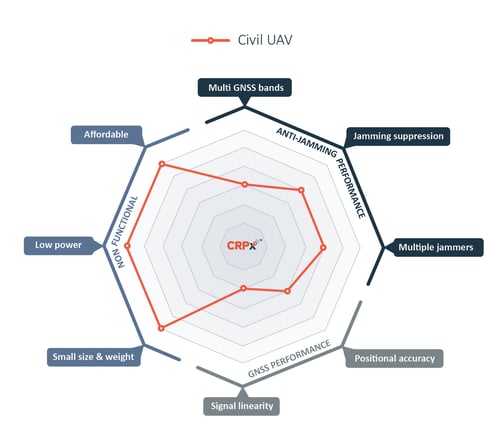
In the case of drones and other UAVs for civil applications, the CRPA inherently needs to be compact, lightweight, and with minimal power drain as well as being affordable within the context of the platform it's protecting hence these aspects need to be prioritised.
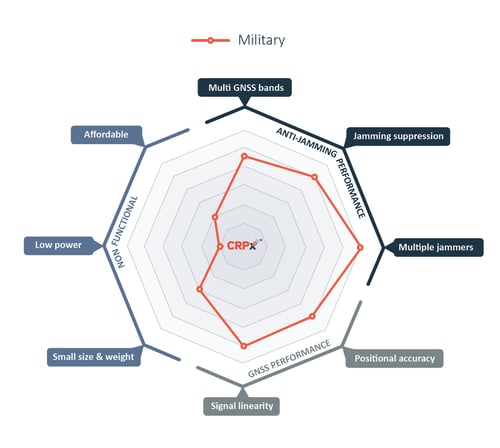
In military deployments on the other hand, anti-jamming performance is paramount and must be prioritised.
Equally important is maintaining linearity in the signal provided to the GNSS receiver to enable monitoring for anomalies within anti-spoofing algorithms without triggering false-positives.
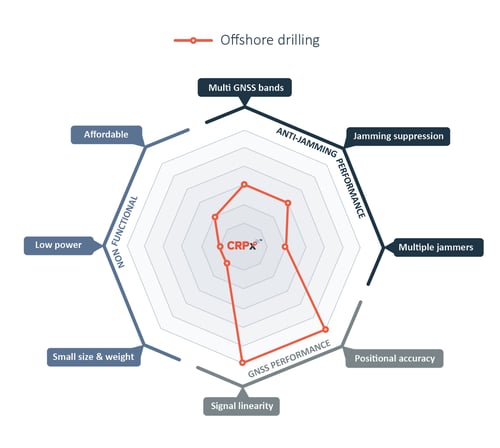
Other applications, such as offshore drilling, are crucially dependent on maintaining high precision in order to function hence will need CRPAs that facilitate accurate phase-based carrier measurements.
In this case, size, weight and power are likely to be less of an issue.
Clearly, designing a CRPA to meet all these diverse and often conflicting needs is going to be tricky.
Helix Geospace CRPx GNSS Anti-Jamming System
Helix Geospace set out to address this challenge, engineering a CRPA capable of delivering military-grade jamming suppression, whilst still acting as a 'transparent' GNSS antenna towards the GNSS receiver for high positional accuracy, and in a compact, lightweight and power-efficient form factor suited to a range of defence and civil applications.