

Combining Helix Geospace's CRPx with GNSS/GPS receiver anti-jamming/spoofing provides the highest levels of resilience.
What's the threat?
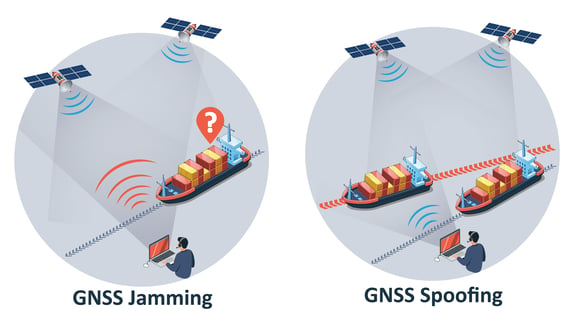
GNSS signals are inherently weak and easily overpowered by strong RF signals emitted by attackers seeking to disrupt, deny and spoof GNSS services.
Such jamming attacks have the effect of degrading positional accuracy, potentially to the point of service denial, whilst more sophisticated spoofing attacks fool the GNSS receiver into believing it's somewhere that it's not.
How can this threat be mitigated by a GNSS receiver?
High-end GNSS receivers incorporate a number of mechanisms for detecting, flagging, and mitigating jammers and interference sources.
GNSS receiver anti-jamming capabilities often employ:
- Notch filtering to remove unintentional interference and single-tone/narrowband continuous wave (CW) jammers and interference
- Wideband adaptive processing to handle chirp and swept-spectrum jammers
- Blanking/clipping of ADC samples containing excessive energy to mitigate pulsed or burst interference
Some GNSS receivers may also incorporate algorithms that look for signal anomalies indicative of spoofing, and/or support Galileo OSNMA anti-spoofing authentication.
Are GNSS receiver anti-jamming/spoofing algorithms sufficient?
Good as receiver-based approaches can be in handling interference, there remain situations in heavily contested GNSS environments in which the magnitude and sophistication of adversarial jamming can overwhelm the receiver's capabilities.
For instance, high-power attacks that saturate the receiver front-end (Automatic Gain Control hijacking), and/or sophisticated attacks that employ especially complex chirp and swept waveforms that defy efficient filtering.
GNSS receivers can also be vulnerable to PRN denial of service (DoS) attacks in which the receiver is flooded with fake PRN codes that consume resources and overwhelm the receiver’s ability to track legitimate GNSS satellites.
To deal with such attacks, a better approach is to suppress the interference & jamming at the antenna level as a first line of defence using a dynamic antenna array that maximises gain from the GNSS satellites whilst neutralising interference from jammers.
The challenge though is in ensuring that the GNSS signal passed on to the receiver is still linear and phase coherent; if not, it can create havoc for anti-jamming algorithms in the GNSS receiver and trigger false-positives in its anti-spoofing analytics.
Designing a resilient antenna system
Achieving high suppression performance whilst retaining GNSS signal integrity is not easy. The design approach and architecture plays a critical role in determining whether the antenna system will work well with GNSS receiver anti-jamming/spoofing algorithms, if at all.
Many designs, for example, rely heavily on digital filtering and adaptive spectral suppression in an attempt to achieve the desired J/S performance but in the process often create residual spectral ripples that distort the GNSS signal. Moreover, such approaches are often also reliant on regenerating the GNSS waveform post processing, but doing so removes vital information used to fingerprint genuine GNSS satellites to detect spoofing and also results in a signal that is no longer bit-faithful to the original hence will fail OSNMA authentication.
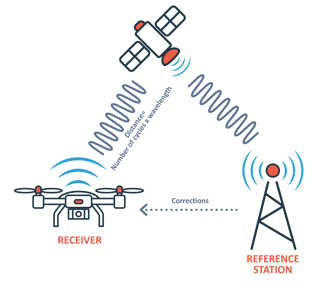
Any distortion introduced into the GNSS signal not only impacts on the efficacy of the GNSS receiver’s anti-jamming/spoofing capabilities, but also the positional accuracy it is able to achieve, and especially so in the case of RTK systems which rely on precise phase measurements.
So what's different with Helix Geospace's CRPx?
By combining innovative antenna array design using their patented DielectriX technology, and a fully transparent signal processing chain, Helix Geospace have been able to develop a solution capable of delivering military-grade suppression (>50dB) whilst ensuring GNSS signal linearity and phase coherence for use with GNSS receiver anti-jamming/spoofing algorithms.
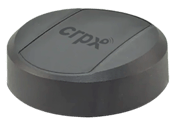
The CRPx GNSS Anti-Jamming System does not reshape, clip, notch, or re-synthesise the GNSS waveform in any way and thereby delivers a clean, linearly beamformed RF signal that the GNSS receiver can use without modification or loss of carrier-phase fidelity.
Moreover, CRPx is able to achieve this in a compact, lightweight footprint suitable for a range of land, sea and air applications.