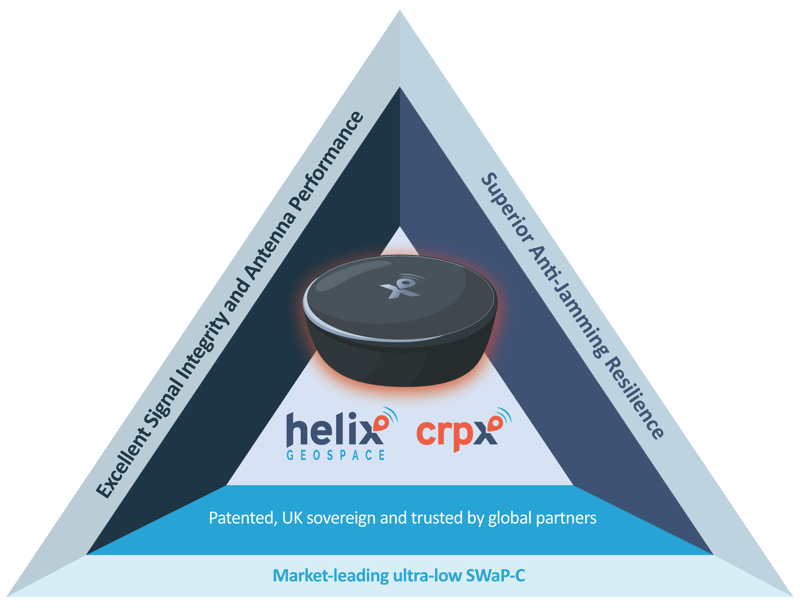
By combining our high precision DielectriXTM  antenna array technology with advanced RF design and innovative signal processing, Helix CRPx delivers military-grade suppression in a small, light and power efficient integrated unit that also maintains GNSS signal linearity for interworking with GNSS receiver anti-spoofing algorithms and high precision positioning (RTK).
Helix CRPX crop

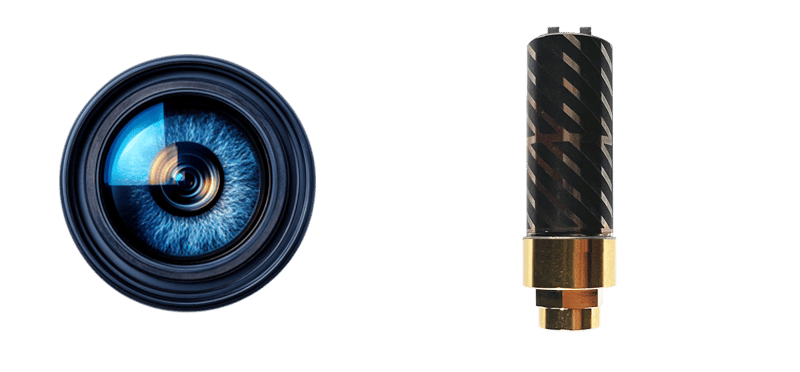
Analogous to a camera in which the lens performance ultimately determines image quality, Helix's patented DielectriX meta-material technology and multi-filar helical design delivers individual antenna elements that are near-identical and extremely precise thereby ensuring high GNSS signal linearity and consistent phase behaviour across the CRPA array.
Lens and antenna 3 small

What level of anti-jamming capability is delivered?

Designed in conjunction with Defence partners, and tested in the field as well as at specialist events (incl. Jammertest), Helix's CRPx provides military-grade jamming suppression:

>50dB; J/S >100dB    >10x better than the competition

JPEG_Jammertest

CRPx has been designed to combat a comprehensive set of jamming attack vectors, including:

  • Narrow-band high-power continuous wave (CW) jammers

  • Wideband chirp/swept jammers that overpower the GNSS signal

  • Tactical (temporal amplitude) jammers that target GNSS receiver Automatic Gain Control (AGC hijacking)

  • Pulse/blink jammers that seek to break GNSS lock to facilitate spoofing

  • Airborne jammers at or near to boresight which makes them harder to null without compromising GNSS signal power

How many simultaneous nulls can CRPx provide?

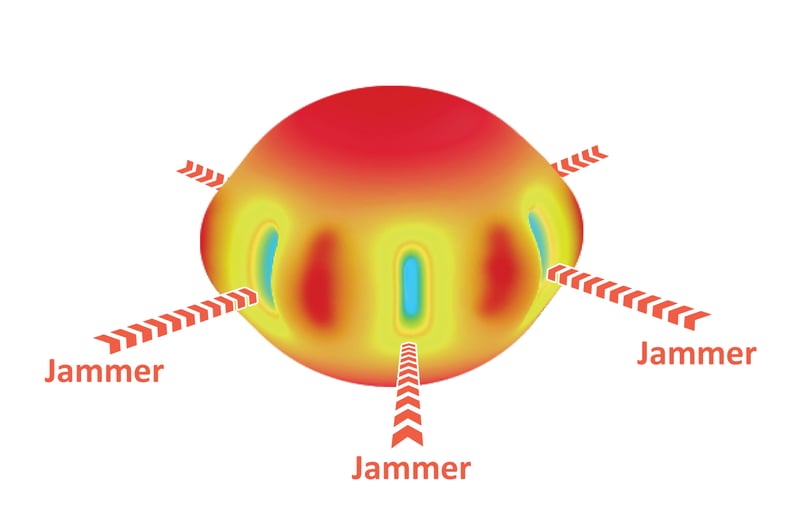
Helix CRPx creates 6 nulls per band, 12 nulls in total to neutralise 2-3x more interference sources than the mainstream competition.

Moreover, it rapidly morphs its pattern to combat changes in the interference and jamming environment and is very fast to react, mitigating the threat of pulse jamming that seeks to knock the receiver out of lock in order to spoof it.
Jamming

Is CRPx robust to denial-of-service (DoS) attacks?

Yes; by morphing its antenna pattern to maximise C/N0, Helix's CRPx is non-blocking by design, suppressing interference and jamming irrespective of the number of sources.

In contrast, complex attacks can quickly exhaust the processing resources of many other competitor CRPAs leading them to fail (DoS attack). Some competitor CRPA designs attempt to combat high numbers of interference and jamming sources by increasing the number of array elements they employ, but this drives up their size, weight, power consumption and cost (SWaP-C).

Does CRPx actively beamform towards satellites under jamming conditions?

Yes; CRPx morphs its antenna array pattern to maximise gain from the GNSS satellites whilst nulling any interference and jamming sources to maximise the C/N0.

In contrast, many other competitor CRPAs rely on digital filtering to reduce the power level of the jammers; they do not beamform at all towards the satellites.

How well does CRPx handle multi-path and adjacent band interference?

Helix DielectriX technology enables the antenna elements to be tightly tuned to the GNSS bands whilst blocking adjacent band interference. The excellent circular polarisation of the design also reduces multipath interference significantly.

Helix's CRPx has no limitation on the number of interferers that can be managed.

In contrast, CRPA designs that rely heavily on digital filtering can be overwhelmed due to L-Band interference and simple reflections that exhaust their DSP resources.

Does CRPx support multi-band; multi-constellation?

Yes, CRPx is dual-band (L1/E1, L2/L5/E5a+b), supporting GPS and Galileo for wider satellite diversity as well as C/A, L2C, P/Y and M-code.
CRPx-350

Why not simply use the anti-jamming capabilities of a GNSS receiver?

Good as receiver-based approaches can be in handling interference and basic jamming, there remain situations in heavily contested GNSS environments in which the magnitude and sophistication of adversarial jamming can overwhelm the receiver's capabilities; e.g.,

  • High-power attacks that saturate the receiver front-end (AGC hijacking)

  • Sophisticated attacks that employ especially complex chirp and swept jamming waveforms that defy efficient filtering

  • PRN denial of service (DoS) attacks in which the receiver is flooded with fake PRN codes that consume resources and overwhelm the receiver’s ability to track legitimate GNSS satellites

CRPAs are better suited to act as a first line of defence, but not all are able to interwork seamlessly with GNSS receiver anti-spoofing algorithms - Helix's CRPx does.

Can Helix's CRPx be used with GNSS receiver anti-jamming/spoofing algorithms?

Absolutely; Helix strongly believes that the GNSS receiver is best placed to carry out deep signal processing to mitigate spoofing attacks hence CRPx has been designed not to reshape, clip, notch, or re-synthesise the GNSS waveform in any way thereby delivering a clean, linear RF signal for use with GNSS receiver anti-spoofing algorithms.

Helix's CRPx is compatible with all GNSS receivers, and in particular works very well with Septentrio's AIM+ anti-jamming/spoofing capabilities.

In contrast, competitor CRPA designs often need to regenerate the GNSS signal post filtering which can lead to anomalies that look like spoofing. To avoid false positives, the anti-jamming and anti-spoofing algorithms in GNSS receivers have to be turned off, which undermines the end-end resilience of the GNSS system.

I've heard that CRPAs cannot be used in high-precision applications (RTK); is that true?

For many CRPAs that is indeed true - the digital filtering employed in these designs often distort phase coherence hence precluding their use with carrier-phase GNSS systems such as RTK for improving positioning accuracy.

Helix's CRPx though has been especially engineered using our DielectriX technology to provide a tight phase centre with minimal phase variation, as well as consistent group delay over varied azimuths, and ensure GNSS signal linearity, thereby enabling it to be used with phase-based GNSS systems such as RTK.
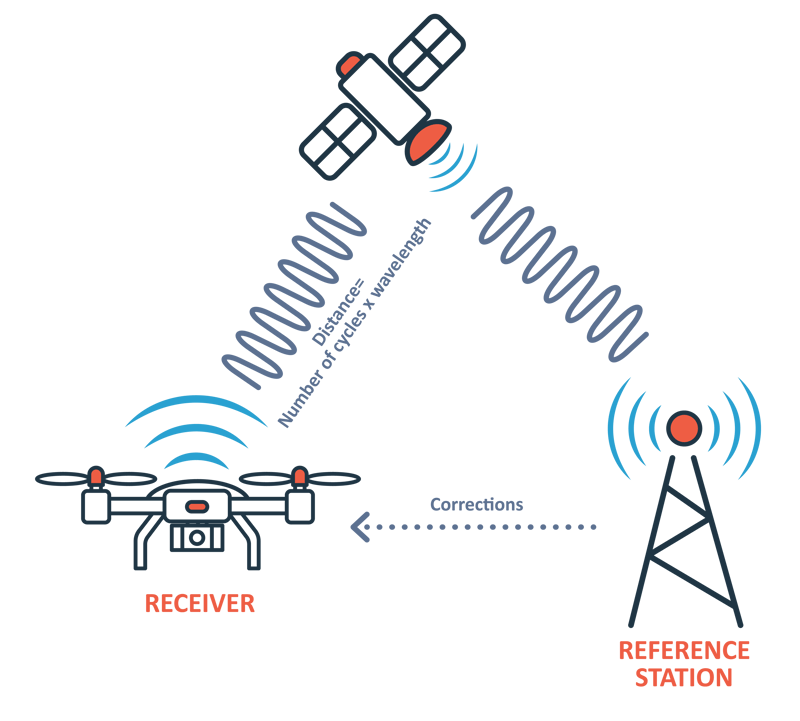

Carrier Phase GNSS

Does CRPx support Galileo OSNMA authentication?

Yes, CRPx employs a fully transparent signal processing chain thereby ensuring that OSNMA messaging is passed transparently through to the receiver.

Competitor CRPAs that employ extensive digital processing and need to regenerate the GNSS waveform post-processing will output a signal that is no longer bit-faithful to the original hence failing OSNMA authentication.

Icon_Documents

Is CRPx easy to install?

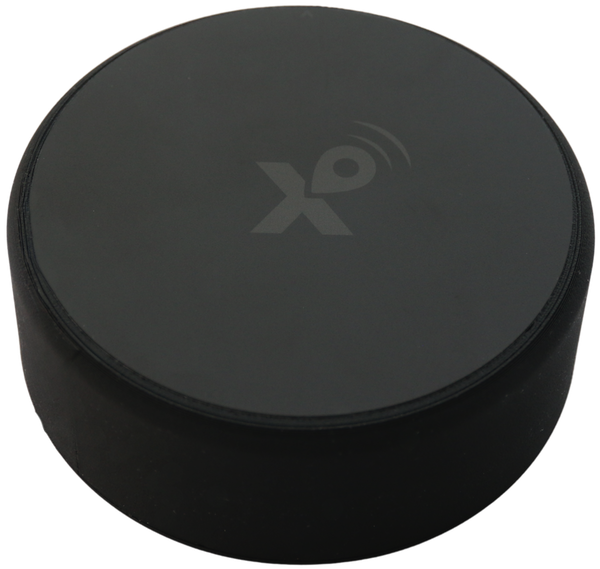
Yes; Helix CRPx is a compact and lightweight single unit (Ø120mm x 30mm; <500g), 2-5x smaller & lighter than much of the competition and a straightforward swap for your existing GNSS antenna. Just add power.

Icon_Battery

What are the power requirements?

CRPx is very energy-efficient: mean <3W; much lower than the competition, and 5-10x lower than competitor CRPAs that employ extensive digital filtering or large arrays.

Icon_Document

Does it need calibrating?

No; our DielectriX precision manufacturing delivers very high consistency across antenna elements to provide a consistent PCO and low PCV, removing the need for array calibration in the field.

Want to discuss CRPx with one of our experts?

Maximising GNSS/GPS resilience

Utilise CRPx as your first line of defence and combine it with your GNSS receiver anti-spoofing.

Helix's CRPx has been specially engineered to work seamlessly with GNSS receiver anti-spoofing.  

Combine the two for the ultimate in end-end anti-jamming & anti-spoofing resiliency.

Discover more

Engineered for a wide range of applications

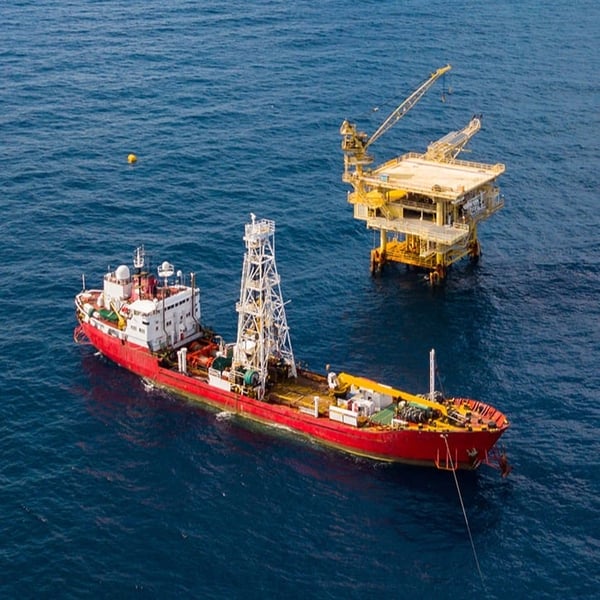
Maritime

GNSS is critical for navigation in modern maritime operations but increasingly under threat.

Learn more
Drones (UAVs)

Resilient GNSS in a compact form factor is fundamental to the operation of drones & UAVs.

Learn more

Military UxVs

Unmanned aerial and surface vehicles (UxVs) are revolutionising modern warfare but crucially dependent on resilient GNSS.

Learn more

Civil Aviation

Mitigating inadvertent GNSS interference from conflict zones is paramount to ensuring the safety of aircraft and crew.

Learn more

where. next. exactly.

Want to discuss CRPxTM with one of our experts